

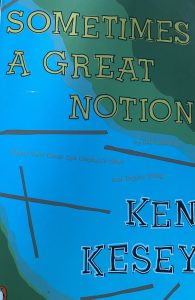
 Sometimes a great notion (Kesey) combines the horror of a forest, the animosity between two step-brothers—not quite Cain & Abel, but getting there— with a lethal love triangle and the destructive forces of capitalism. The third person narration is the glue that holds the story together. Not too many characters but the novel has enough meat and conflict to hold anyone’s interest.
One caveat: The two primary perspectives (POVs) are Hank’s and Lee’s, both told in first person and often jumping between them from paragraph to paragraph, and sometimes, in mid paragraph. The story also jumps backwards and forwards and does somersaults in time without warning, so if you’re squeamish, it’s not for you. Kesey uses the roving, shifting point of view jumping from head to head, moving between characters’ inner thoughts within the same scene, often without dialogue tags. The writing does not require them.
How?
Lee (younger brother)’s internal monitor screams at him in ALL CAPS and sounds slightly deranged, so when you encounter a phrase as though Trump wrote it on social media, you know whose inner voice it is. Viv’s entire essence oozes with longing and restlessness. Hank, older brother, is self-righteous, charming and macho with the distinct pattern of speech that accompanies such personalities. Then, there are the little linguistic tics. When someone says: jest speak. You know who it is. And there is the personification of the forest, (It’s a story about loggers after all) so when you hear the forest, it does not need tags, you can feel its anger (loggers, remember?) and finally, Kesey uses italics magnificently…
So, four characters (there is also the father), an angry forest, a past and present that get mixed up all in the same paragraph, with no tags—half stream-of-consciousness, one-forth interior dialogue, and one forth associative thinking (with echoes of the “collective unconscious” of Jung), all in a lyrical, non-linear, post-modern prose only Kesey could pull off.
May be a tough read if you’re used to linear story-telling, but if you resist Kesey will break your heart (and every rule the MFA schools have thought of) and then he heals it, shows you what great writing means, rules be damned.